Trip Durations
18 Days
Quick Contact
4.9  | 18 Days | Kathmandu - Mera Peak Summit (6,476 M) - Kathmandu
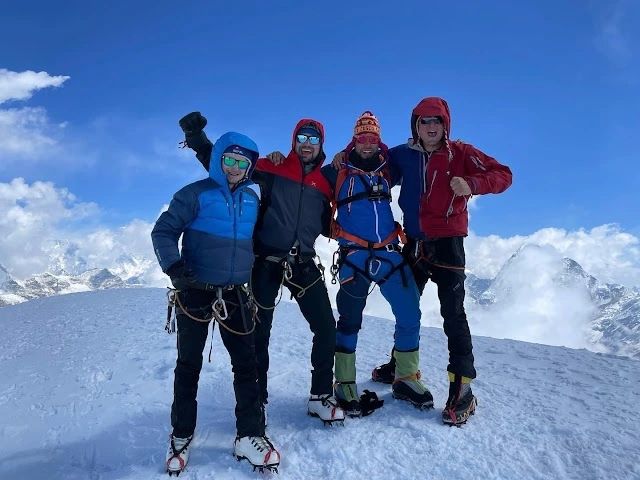
Mera Peak (6,476 m / 21,247 ft) is the highest trekking peak in Nepal and the best first 6,000-metre summit for fit trekkers with little or no mountaineering background. The climb is a long, steady glacier ascent rather than a technical wall, and the reward is a summit panorama that takes in five of the world's 8,000-metre peaks: Everest, Lhotse, Makalu, Cho Oyu and Kangchenjunga.
That does not make it easy. Mera is higher than Island Peak or Lobuche East, the approach through the remote Hinku Valley is long, and most failed attempts come down to altitude, not technique. This guide covers everything our guides tell climbers before they go: difficulty, seasons, the route day by day, permits and costs for 2026, acclimatization, summit day, gear and training.
You will see the summit height quoted as 6,461 m, 6,470 m or 6,476 m depending on the source. Mera has three summits (North, Central and South); 6,476 m is the most widely quoted figure for Mera Central, the summit most climbers reach.
Mera Peak (6,476 m / 21,247 ft) is the highest trekking peak in Nepal and the best first 6,000-metre summit for fit trekkers with little or no mountaineering background. The climb is a long, steady glacier ascent rather than a technical wall, and the reward is a summit panorama that takes in five of the world's 8,000-metre peaks: Everest, Lhotse, Makalu, Cho Oyu and Kangchenjunga.
That does not make it easy. Mera is higher than Island Peak or Lobuche East, the approach through the remote Hinku Valley is long, and most failed attempts come down to altitude, not technique. This guide covers everything our guides tell climbers before they go: difficulty, seasons, the route day by day, permits and costs for 2026, acclimatization, summit day, gear and training.
You will see the summit height quoted as 6,461 m, 6,470 m or 6,476 m depending on the source. Mera has three summits (North, Central and South); 6,476 m is the most widely quoted figure for Mera Central, the summit most climbers reach.
|
Fact |
Detail |
|---|---|
|
Summit height |
6,476 m / 21,247 ft (Mera Central) |
|
Summits |
Three: Mera North, Mera Central and Mera South |
|
Location |
Mahalangur range, Solukhumbu district, Koshi Province, inside Makalu Barun National Park |
|
First ascent |
May 1953, by J.O.M. Roberts and Sen Tenzing Sherpa |
|
Managed by |
Nepal Mountaineering Association (NMA) |
|
Peak type |
NMA trekking (climbing) peak, the highest in that category |
|
Alpine grade |
PD (peu difficile): glaciated, non-technical, short 40–50° headwall near the top |
|
Trip length |
16 to 20 days from Kathmandu; 18 days recommended |
|
Days of climbing |
2 (Khare to High Camp, then summit day) |
|
Highest sleeping point |
Mera High Camp, about 5,780 m |
|
Base for the climb |
Khare (5,045 m), the last teahouse village |
|
Gateway |
Flight to Lukla (2,860 m) |
|
Accommodation |
Teahouse lodges up to Khare; tented camp at High Camp |
|
Best seasons |
Spring (April to May) and autumn (October to November) |
|
Group size |
1 to 12 climbers |
|
Guide |
Mandatory: independent climbing on Nepal's trekking peaks is not permitted |
|
Summit views |
Everest, Lhotse, Makalu, Cho Oyu, Kangchenjunga, Baruntse, Chamlang, Ama Dablam |
Mera Peak is technically easy but physically hard. If you can hike 6 to 8 hours a day for two weeks and are willing to learn crampon and rope basics, you can climb it. What decides success is how your body handles altitude above 5,000 m.
What makes it manageable:
What makes it hard:
Who is it right for? Trekkers who have done a 5,000 m trek (such as Everest Base Camp or the Annapurna Circuit), or very fit first-timers who follow a slow acclimatization itinerary. No previous mountaineering is required; your guide teaches crampons, ice axe, harness and jumar skills at Khare before the climb.
Mera vs Island Peak: Island Peak is lower but more technical, with a steeper headwall and an exposed summit ridge. Mera is higher but gentler. Many climbers do Mera first, then Island Peak via the Amphu Lapcha pass on a longer combined trip.
The best months are mid-October to mid-November and late April to May. Autumn gives the clearest views and most stable weather; spring is slightly warmer with rhododendrons in bloom on the lower trail, but afternoon cloud is more common and the permit costs twice as much.
|
Season |
Months |
Conditions |
Verdict |
|---|---|---|---|
|
Autumn |
September to November |
Clear skies after the monsoon, cold nights, stable snow. Busiest season. |
Best |
|
Spring |
March to May |
Warmer days, longer daylight, some afternoon cloud and wind. |
Excellent |
|
Winter |
December to February |
Very cold (minus 30 °C possible at the summit), deep snow on Zatrwa La, few lodges open. |
Experienced climbers only |
|
Monsoon |
June to August |
Rain, cloud, leeches, frequent Lukla flight cancellations. |
Not recommended |
Tip: In autumn, aim for a summit date in the last week of October or first week of November. Early October can still hold post-monsoon cloud; late November gets noticeably colder and windier.
You may also like
Everest Base Camp Trek 14 Days With Nepal Trekking Trail. Explore The Legendary Everest Base Camp, Sherpa Villages, Namche Bazaar, Tengboche, Kala Patthar And Breathtaking Himalayan Views. View Details →
Everest View Trek 7 Days With Nepal Trekking Trail Offers A Short Everest Adventure To 3,880m With Everest Views, Namche Bazaar, Sherpa Villages, Itinerary, Cost And Expert Guides. View Details →
Experience The Gokyo Valley Trek 12 Days With Nepal Trekking Trail. Explore Gokyo Lakes, Climb Gokyo Ri At 5,357 M, And Enjoy Spectacular Everest, Lhotse, Makalu And Cho Oyu Views. View Details →